

Beauregard's Tailor
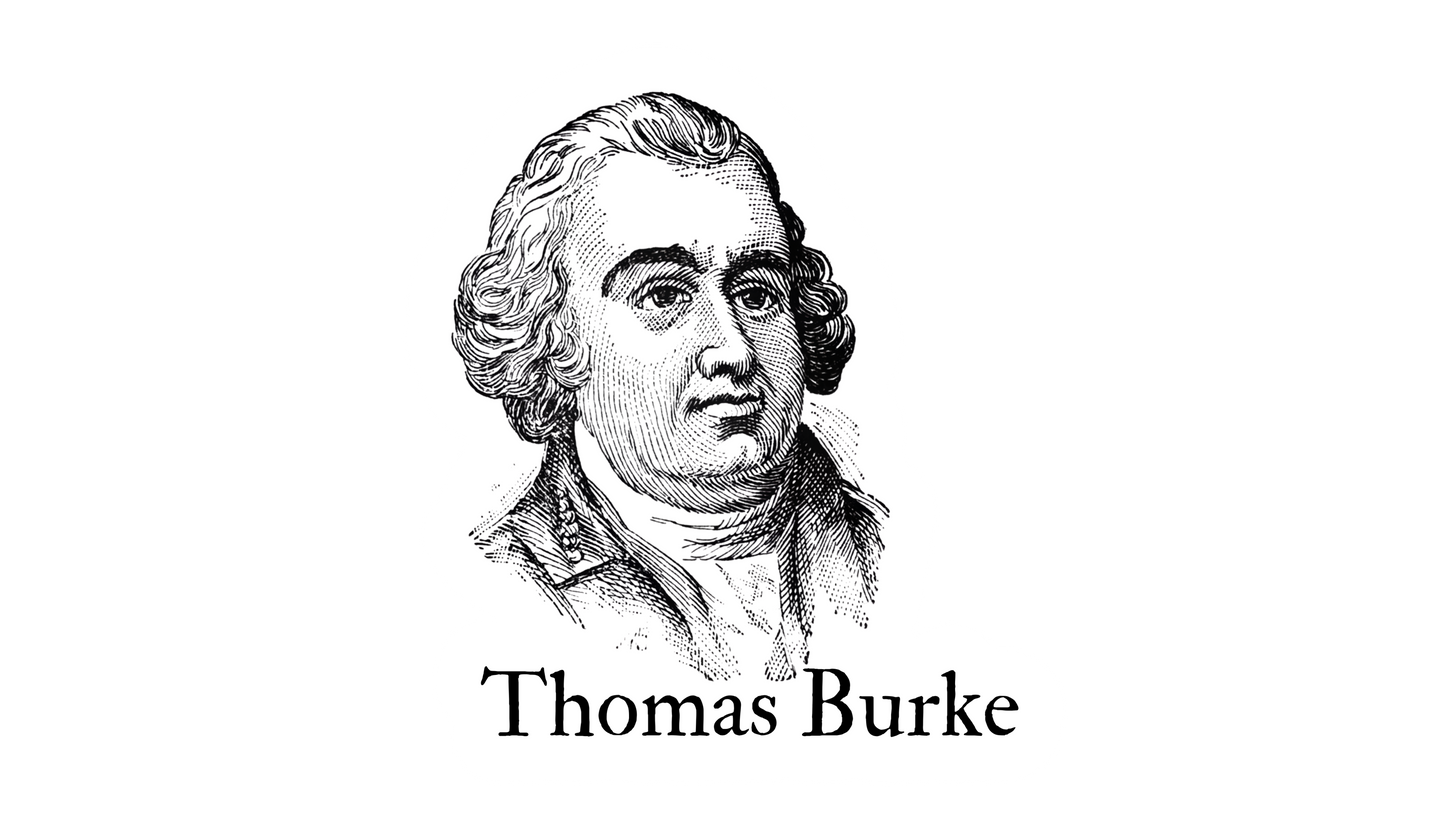
Governor Thomas Burke - North Carolina
Governor Thomas Burke - North Carolina
Couldn't load pickup availability
A native of Ireland, Thomas Burke served as the third governor of North Carolina under the 1776 constitution. He played an instrumental role in the committee that submitted the Halifax Resolves to the Continental Congress in Philadelphia. A one-term governor, he was imprisoned by Loyalists, taken to Charleston, South Carolina, escaped and resumed the governorship, and then resigned in 1782.
Born in Ireland in 1744, Burke later migrated to Norfolk, Virginia. In 1772, he and his family (wife, Polly, and one child, Mary) moved to Hillsborough, North Carolina. There he started practicing law and operating a plantation.
Burke’s political career and influence began shortly after he arrived in North Carolina. Although he served in three of the Provincial Congresses, his work in the Fourth Provincial Congress (1776) is worth explanation. As part of a committee that included Cornelius Harnett and Abner Nash, Burke evaluated “the usurpations and violences attempted and committed by the King and Parliament of Britain against America.” The committee empowered delegates to the Constitutional Convention in Philadelphia to declare independence. When the Constitutional Convention met, the Halifax Resolves, the name given to the committee’s report, was read to all delegates. Simply put, Burke was part of the first calls for independence in what would become the United States of America.
In 1781, Burke became governor of North Carolina. He assumed office during a turbulent time; guerilla bands, Loyalist and Patriot, terrorized the countryside. Burke desired a return of law and order, so he, according to historian Michael Hill, took “extraordinary measures to reform the militia, increase essential revenues, banish intractable Loyalists, and defend against renewed British attack from Virginia and South Carolina. Acting on his own authority, he established special courts and assumed for himself veto power over legislative acts.”
Three months after Burke took office, Loyalist militia commander David Fanning attacked Hillsborough and captured 200 prisoners, including Governor Thomas Burke. The executive was transported to Charleston, South Carolina. He received a parole in two months, yet he escaped and returned to Hillsborough to resume his gubernatorial duties. Many of Burke’s colleagues and contemporaries, write some historians, considered this escape to be a dishonorable parole violation. Burke resigned in 1782, only ten months after assuming office.
He died in September 1783.
Abbeville Institute:
Edmund Burke is rightly revered in English politics as one who nearly single-handedly steered the government of Great Britain away from friendship or compromise with the atheistic Revolutionaries in France and preserved the ancient, salutary traditions of England when it appeared that nothing would be able to withstand the crushing waves of the diabolical doctrine of the Rights of Man.
But the South is not without her own Burke worthy of great renown. Like his contemporary in England, Thomas Burke was also born in Ireland (about 1744, County Galway), but he made his mark in politics not in any European country but as a representative of North Carolina in the Continental Congress during the War for Independence from the British Empire.
After finishing his education in Ireland, he emigrated about 1759 or 1760 to Virginia due to some family disagreements where he initially worked as a physician in Norfolk before becoming a lawyer. In Ol’ Virginny he married Mary ‘Polly’ Freeman (1770), who bore him a daughter, also named Mary. Mr Burke, multi-talented, would take up the writing of poetry as well during those years in Virginia.
In 1772 he and his family moved to a plantation near Hillsborough, North Carolina, and he continued his law practice. His entrance into politics came in 1775 when he served as a delegate to the second provisional congress of North Carolina. After reelection to that post, he served in April 1776 as the chairman of the committee to draft a new constitution for his State. From thence, because of his manifest talents, he was selected as a delegate to the Continental Congress. His work there would leave an indelible mark upon the constitutional theory and practice of the United States.
From the moment he took his seat at the Congress, he noted a tendency of some of the delegates to expand the powers of the Continental Congress at the expense of the States through either the claims of necessity or implied powers. This concerned him immensely, for he saw this as a transfer of the struggle the States had recently been fighting with the British Parliament to the new Continental Congress:
‘During the Imperial Crisis, Alison LaCroix writes, Americans “began to push toward a system that formally recognized two distinct levels of government within the empire, each with its proper sphere of legislative power.” The key to this arrangement was to find a mutually acknowledged boundary between the two levels, marking the jurisdiction of each. The colonies and Parliament could never discover that boundary. Then, in February 1777, Burke realized that the lack of a boundary threatened the Revolution. He and James Wilson could not agree about jurisdiction over deserters because there were no mutually agreed-upon boundaries. Thus, two well-meaning patriots clashed and reignited the metropolitan-periphery issue.
‘Burke wanted clean jurisdictional boundaries to prevent usurpations by either side.’
This led him to introduce his amendment to the Articles of Confederation, which came to be known as the Burke Amendment.
On April 8, 1777, the Congress began work once again on the proposed Articles of Confederation for the States –
‘Burke noted that by April 29, Congress had “agreed to three articles: one containing the name; the second, a declaration of the Sovereignty of the States, and an express provision that they be considered as retaining every power not expressly delegated; and third an agreement mutually to assist each other against every enemy.” . . .
‘Burke proposed a slight, but important, rearrangement of the first few articles of the Dickinson Draft. He moved Dickinson’s second article, which called the union a “firm league of friendship,” to the third article. He then took Dickinson’s third article, reworked it, and inserted it as Article II. Dickinson’s third article had read, “Each Colony shall retain and enjoy as much of its present Laws, Rights and Customs, as it may think fit, and reserves to itself the sole and exclusive Regulation and Government of its internal police, in all matters that shall not interfere with the Articles of this Confederation.” Burke’s Article II noted, “Each state retains its sovereignty, freedom, and independence, and every power, jurisdiction, and right, which is not by this Confederation ex-pressly delegated to the United States, in Congress assembled.”’
Some have tried to make the case that Burke’s change introduced a sort of divided sovereignty between the general government and the States, but his own writing about the amendment dispels any such notions. The States, he said, reserve their whole sovereignty:
‘First, he insisted, as he had in the February congressional debates, that “all sovereign Power was in the States separately.” Second, “particular acts” of power, he noted, “which should be expressly enumerated, would be exercised in conjunction, and not otherwise.” Thus, Congress did not have power on its own; rather, all its powers derived from the states. Third, regarding non-enumerated powers, “each State,” he insisted, “would Exercise all the rights and powers of sovereignty, uncontrolled.”’
Burke’s revisions were supported by almost every State’s delegation:
‘Article II passed with eleven states in support. Virginia opposed it, and New Hampshire split its vote. Burke concluded, “I was much pleased to find the opinion of accumulating powers to Congress so little supported, and I promise myself, in the whole business I shall find my ideas relative thereto nearly similar to those of most of the States.” Burke made a strong point. The overwhelming support for Article II seemed to demonstrate an appreciation of state sovereignty throughout the thirteen states and a disavowal, at this time at least, of the nationalists’ agenda.’
Virginia’s opposition was an anomaly due to personal disagreements between Virginia’s Richard Henry Lee and Mr Burke; State sovereignty was strongly supported in Virginia at this time. Thus, the support for Mr Burke’s amendment was nearly unanimous at the Congress.
Tom Burke grounded his amendment upon two main arguments, one leading to the other. First, the Declaration of Independence clearly announced to the world that each of the States were separate, independent nations, possessing the fulness of sovereignty:
‘The Burke Amendment can be seen as constitutionalizing the status of the states as arguably described in the last paragraph of the Declaration of Independence. The Declaration called the colonies “FREE AND INDEPENDENT STATES” and indicated that they had traditional powers of sovereignty, that is, making war and peace and conducting trade. By July 1776, Congress was exercising these powers on behalf of the states, a fact that led some to conclude that Congress was sovereign. But Burke, and other congressmen, read this alternatively as indicating that the states were indeed the sovereigns, free and independent. States were the basis of authority in the undefined union they shared.’
This being so, Vattel’s Law of Nations made it clear that countries joining together to form a confederation, as the States were now doing with the Articles, did not give up their sovereignty:
‘Burke’s theory was not a novelty but was supported in the law-of-nations writings that he knew. Law-of-nations theory plainly envisioned political arrangements in which governments could cede sovereign powers, but not sovereignty itself, to a central agent. Burke understood the issue this way and was familiar with the law of nations, as he cited it several times during his February 1777 congressional speeches. In his 1758 Law of Nations, Vattel de-scribes a confederation seemingly like the one Burke had in mind in April 1777. Vattel maintained that separate states could confederate “without ceasing to be, each individually, a perfect state.” He then insisted that in such a “federal republic,” the “joint deliberations” of the states “will not impair the sovereignty of each member, though they may, in certain respects, put some restraint on the exercise of it, in virtue of voluntary engagements.” In other words, if states granted powers to a central government, they gave up the exercise of these powers, but their consent left them in possession of their fundamental sovereignty.’
Despite the approval of his changes, Mr Burke remained negative in his outlook about the proposed Articles, believing they did not go far enough in restricting the powers of the general government. Nevertheless, his part in the politics of North Carolina and the confederation of States was fast coming to a close. Divine Providence withdrew him quickly from this world. He left the Continental Congress in 1781, was elected governor of North Carolina in June of that year, was captured in October by Tories, and then paroled. After leaving the governorship in 1782, he lived another year before succumbing to complications caused by his imprisonment on December 2nd, 1783.
Despite his personal absence from the constitutional debates, his legacy remained very influential. The Burke Amendment would serve as the model of the Tenth Amendment to the current federal constitution, which has helped to preserve some shreds of State sovereignty in the face of the federal vortex that is intent on pulling every meaningful power and authority away from the States and localities and making them its own.
Other than the War between the States, there has probably never been a time filled with more confusion and violence in the union than our own time. We are much in need of both an Edmund Burke and a Thomas Burke today: the first as a prophetic voice to renew and strengthen the traditions that make life worth living (Christianity, stable social orders and hierarchies, recognizable and heritable cultures – political and otherwise, etc.); and the second to help reorganize the political structure of the union so that the proper balance between center and periphery can be fixed, allowing for more peaceful, less contentious relationships between the States to be formed.
We will see how all of this turns out in the days ahead, with God’s help. But whatever betide, Dixie may be proud that one of her sons, Thomas Burke, helped lay the foundation stone that has preserved some measure of balance in the political system of the United States to this very day.
Share