

Beauregard's Tailor
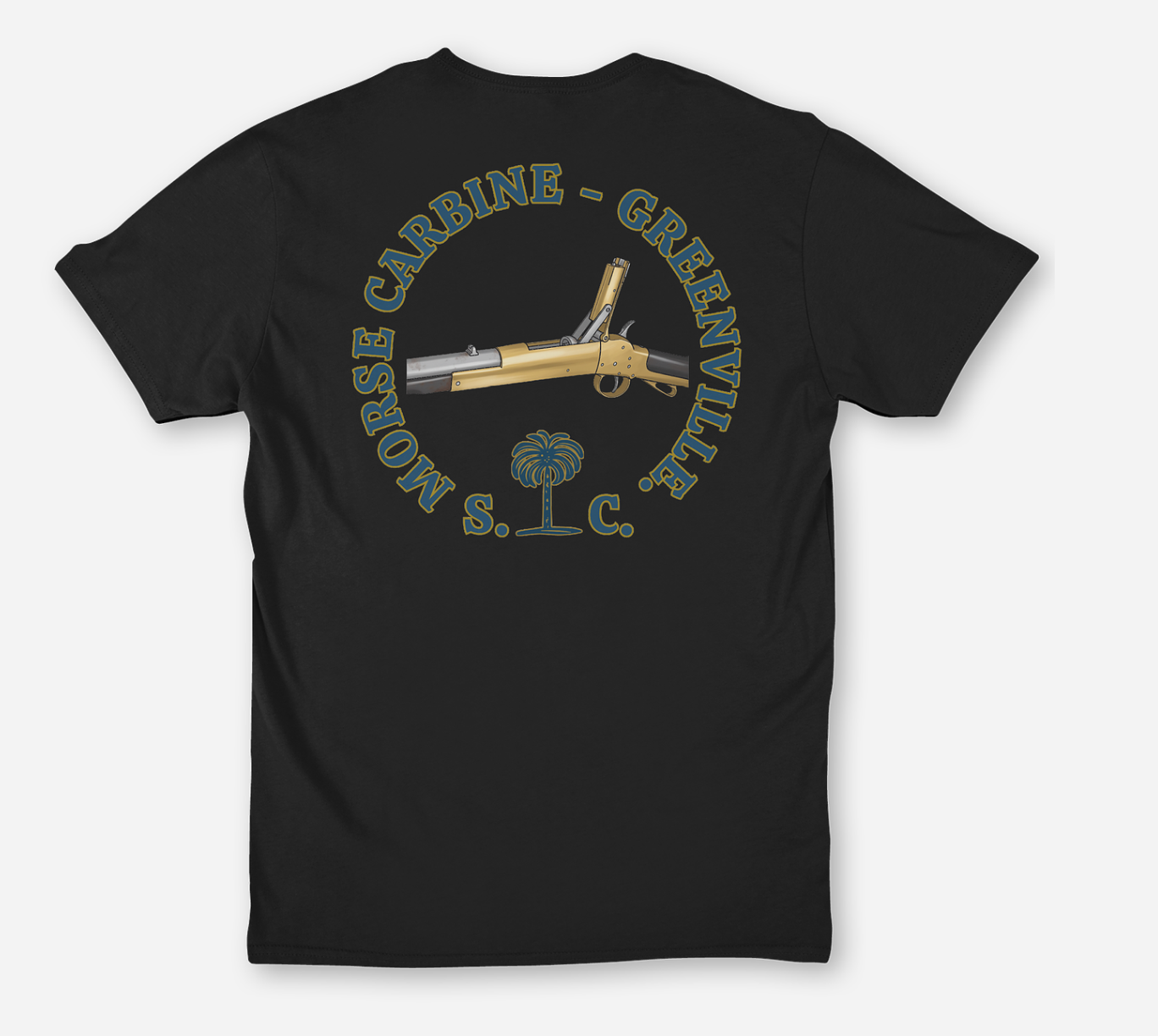
Morse Carbine - Greenville, SC Shirt
Morse Carbine - Greenville, SC Shirt
Couldn't load pickup availability
The breech loading carbine was invented by George W. Morse. In December of 1862, South Carolina recommended that one thousand or more of G.W. Morse’s patented carbines be manufactured. Morse first set up a manufactory in Nashville, Tennessee, but shortly moved the machinery to Atlanta, Georgia. While it is generally assumed that all Morse carbines were manufactured at the State Military Works in Greenville, South Carolina, a reporter for the Atlanta Intelligencer wrote in late 1862 that he had been shown a carbine made by H. Marshall in Atlanta. He goes on to describe the carbine in great detail and it is without a doubt a Morse patent carbine. Why this has not been further explored I do not know. Perhaps it was only a prototype, but if so, the machinery to make the carbine would have had to have been transferred to the Greenville State Works, where production resumed in 1864. Surviving records show that in the second quarter of 1864 the Works turned out 100 carbines, and another 200 in the third quarter of 1864. This would have been a total of 300 produced at the State Works up to the end of the third quarter of 1864. During the same time period, the State Works issued 298 of the carbines and had another 500 on hand. From this record, it would appear that at minimum, the first 500 carbines were produced at H. Marshall & Company in Atlanta, Georgia. This production began in late 1862 and continued into 1863, and perhaps far into 1863. In Confederate Longarms and Pistols, Anthony and Hill place these guns as having been made in Atlanta. Madaus and Murphy, in their masterpiece Confederate Carbines & Musketoons, state that it is an "accepted fact” that they were all made in South Carolina. However, as the records quoted above show, it is not an "accepted fact”. There can be no doubt that many of the early Morse carbines were produced in Atlanta.
Approximately one thousand of these advanced carbines were manufactured. Morse’s weapon was far ahead of its time, too far it seems, because cartridge manufacture techniques lagged behind. The problems of securing enough of its center fire, metallic cartridges proved insurmountable. Production ended in late 1864, when the machinery was relocated to the Confederate arsenal at Columbia, South Carolina. All of the machinery was destroyed when Sherman sacked Columbia.
Share