

Beauregard's Tailor
William Washington Sticker
William Washington Sticker
Couldn't load pickup availability
A second cousin to George Washington, William Washington was a distinguished field officer of the Continental Army during the War for American Independence. He led one of the two infantry vanguards into the Hessianoutpost during the Battle of Trenton and later achieved laurels for his intrepidity as commander of a regiment of light dragoons during the southern campaigns of 1781 under Major General Nathanael Greene. After surrendering at Yorktown, Brigadier General Lord Charles Cornwallis would publicly remark that “there could be no more formidable antagonist in a charge, at the head of his cavalry, than Colonel William Washington.”
William Washington was born on February 28, 1752 to Bailey and Catherine Washington in Stafford County, Virginia. At the outbreak of the American Revolution, he was elected a captain of Stafford County Minutemen on September 12, 1775, which was integrated into the Third Virginia Regiment in February 1776. The unit was ordered to join the main Army in New York in the late summer of the same year, where Washington led a successful charge against the Hessian artillery at the Battle of Trenton on December 26, 1776. Wounded in this action, Washington was rewarded with a promotion to the rank of major and assigned to the newly created Fourth Regiment of Continental Light Dragoons upon recovery.
By the end of 1779, Lieutenant Colonel Washington commanded the Third Regiment of Continental Light Dragoons. While en route to join the besieged patriot army in Charleston, South Carolina, his weakened regiment was assigned to a detachment of light troops, commanded by Brig. Gen. Isaac Huger, outside of the city to reconnoiter and screen against the advancing British army. The British Legion, commanded by the feared Lt. Col. Banastre Tarleton, surprised and routed the patriots at Monck's Corner on April 14, leaving Maj. Gen. Benjamin Lincoln's Continental army in Charleston without a signficant cavalry force. Washington and the surviving troops fled across the Santee River after the engagement and were later defeated at Lenud's Ferry on May 6.
After refitting in North Carolina, Washington's forces successfully captured Rugeley's Fort near Camden, South Carolina. On January 17, 1781, Washington shone brightest at the Battle of Cowpens by countering and routing the charge of the enemy cavalry. Congress awarded him a silver medal, one of only eleven to be awarded during the war, for his role in the battle. Washington also led his regiment at the Battles of Guilford Courthouse in March and Hobkirk Hill in April. At the Battle of Eutaw Springs, on September 8, 1781, Colonel Washington was severely wounded while leading a charge and was subsequently captured, ending his military service in the war. Military historians have questioned the wisdom of Washington's charge through thick vegetation at the Battle of Eutaw Springs.
As a prisoner of war, William Washington spent the remainder of the war in Charleston. During the war, he met and married Jane Elliott, acquiring her Sandy Hill plantation, where he lived the life of a lowcountry planter. He had a friendly agricultural relationship with George Washington, sending seeds of local plants to Mount Vernon. He also hosted President Washington during his southern tour in 1791 at his plantation home south of Charleston.
William Washington pursued public office at the state level after the American Revolution, serving as a representative from 1787 to 1791 and then senator from 1792-1794, and again from 1802-1804 to the state assembly. In 1794, he was appointed to the command of a brigade of the state militia. During anticipated hostilities with France in 1798, he was appointed a brigadier general in the regular Army. After a prolonged illness, Washington died on March 6, 1810.
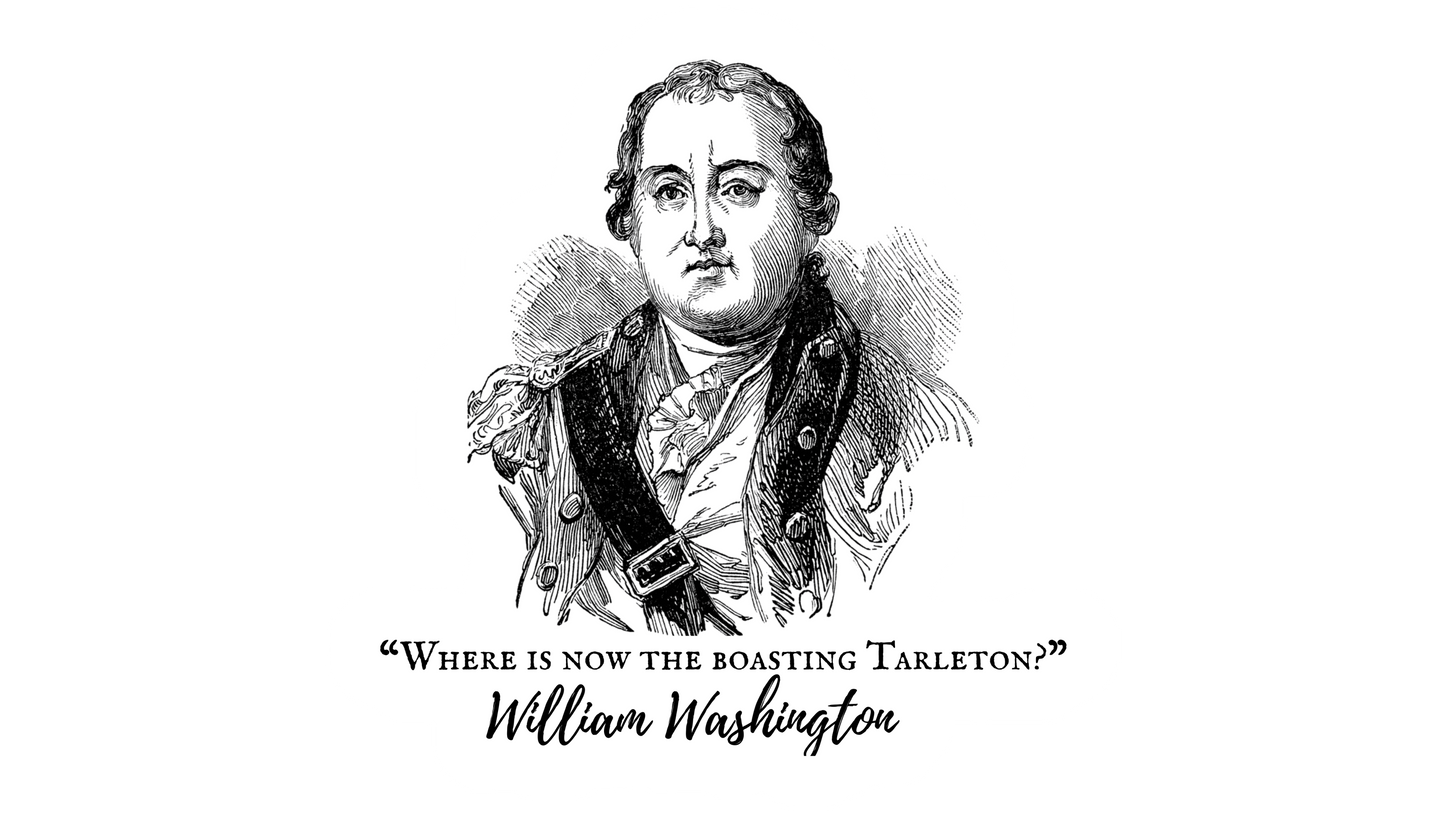
Design includes William Washington and a quote from his directed armed encounter with Tarleton at the Battle of Cowpens:
With the main British infantry surrender and during Tarleton's retreat, Washington was in close pursuit and found himself somewhat isolated. He was attacked by the British commander and two of his men. Tarleton was stopped by Washington himself, who attacked him with his sword, calling out, "Where is now the boasting Tarleton?" A cornet of the 17th, Thomas Patterson, rode up to strike Washington but was shot by Washington's slave orderly trumpeter. Washington survived this assault and in the process wounded Tarleton's right hand with a sabre blow, while Tarleton creased Washington's knee with a pistol shot that also wounded his horse. Washington pursued Tarleton for sixteen miles.
Share